
Driving Tips and Car Maintenance Advice
Fuel prices in the UK have rarely felt more urgent than they do right now.
Since late February 2026, escalating conflict in the Middle East and the disruption to the Strait of Hormuz have sent wholesale oil prices sharply higher, and UK drivers have felt the impact almost immediately at the pumps.
According to RAC Fuel Watch, petrol and diesel posted their biggest monthly price increases on record in March 2026, with unleaded rising by around 20p per litre in a single month and diesel jumping by roughly 40p. By early April, average diesel prices had reached 187p per litre, with petrol at 156p, and some forecourts in London and on motorways were charging above 200p.
Average diesel prices reached 187p per litre in early April 2026, up more than £21 for a full 55-litre tank compared to just six weeks earlier. Petrol is averaging 156p, with motorway services charging significantly more.
This is not simply a blip. The disruption to the Strait of Hormuz, a waterway that carries roughly 20 per cent of the world’s oil supply, is a structural pressure on prices that could persist for months. For most Essex drivers, the car is not optional, which makes efficiency more important than ever. The good news is that a great deal of what you spend at the pump is within your control.
Research from the Energy Saving Trust suggests adjusting how you drive, without spending a penny on the car itself, can cut fuel costs by 10 to 15 per cent. Combine that with a properly maintained vehicle, and the savings become even more substantial.
At Clover Autos, we work with drivers every day who are surprised by how much their fuel economy improves after a proper service. This guide covers both sides of the equation: what you can do at the wheel, and what your car needs under the bonnet.
Why fuel efficiency matters more than ever in 2026
The current spike has two distinct elements worth understanding. The first is price. The conflict affecting major oil shipping routes has pushed crude above $100 a barrel, and that feeds through to UK pump prices within days. The second is supply anxiety. Some forecourts experienced temporary shortages in late March as drivers rushed to fill their tanks before prices rose further. Asda acknowledged that demand surged significantly, resulting in some pumps running dry at select stations. Industry bodies and the government were quick to confirm that overall national supply remained stable and that the disruption was driven by panic buying rather than a genuine national shortage.
The practical lesson is straightforward: the bigger problem right now is price, not scarcity. And price is something you can do a great deal about through smarter driving and a well-maintained car. A vehicle overdue a full service will almost always use more fuel than one that is properly maintained, regardless of how carefully the driver behaves behind the wheel.
The driving habits that burn the most fuel
Most fuel is wasted not on motorway runs but in the daily, unremarkable journeys close to home. These are the habits that cost you the most.
Harsh acceleration from a standstill
Pushing hard on the accelerator from a standing start forces the engine to work far harder than it needs to. The fuel burned to reach speed quickly is disproportionate to what is needed if you build speed gradually. This is especially pronounced in stop-start urban traffic, where the cycle of hard acceleration followed by braking repeats dozens of times per journey.
The practical fix is simply to look further ahead. If the lights are red, if traffic is building, if a roundabout is coming, ease off earlier and let the car slow itself down before you need to. You will reach the same point having used a fraction of the fuel.
Driving at the wrong speed on faster roads
There is a fuel-efficiency sweet spot on most petrol and diesel cars, typically between 45 and 60 mph on open roads. Above 70 mph, aerodynamic drag increases sharply and the engine has to work significantly harder to maintain speed. The AA estimates that driving at 80 mph instead of 70 mph uses up to 25 per cent more fuel. With diesel now approaching 190p per litre in some areas, the cost of that extra speed has never been more tangible.
Carrying unnecessary weight and drag
Many cars are used as rolling storage units. Roof boxes, bike racks, golf clubs, tools and bags earmarked for the tip all add weight. A 50 kg load in the boot increases fuel consumption by roughly 2 per cent. A roof box with nothing in it can reduce efficiency by up to 10 per cent due to aerodynamic drag alone. Remove anything you do not regularly need, and detach roof-mounted accessories when they are not in use.
Unnecessary idling
Sitting with the engine running while stationary burns fuel and produces emissions without moving you anywhere. Modern fuel-injected engines do not need to warm up by idling; they reach operating temperature faster when driven gently. If you are parked up and waiting for more than a minute, switching off the engine is the more economical choice.
How your car’s condition directly affects fuel economy
Driving technique accounts for a significant part of fuel consumption, but it is only half the picture. A car that is not properly maintained will use more fuel regardless of how carefully you drive it.
Tyre pressure
Under-inflated tyres create greater rolling resistance, forcing the engine to work harder with every revolution of the wheels. A tyre just 6 PSI below its recommended pressure increases fuel consumption by around 3 per cent. Check pressures at least once a month and before any long journey. If you are unsure of your tyres’ condition, our tyre health checks can identify pressure issues and flag anything that needs attention before it affects safety or economy.
Engine oil and filter condition
Old or incorrect engine oil increases internal friction, which the engine must overcome by burning more fuel. A blocked air filter restricts oxygen to the combustion chamber, disrupting the fuel-air mixture and reducing efficiency. Dirty fuel injectors deliver fuel unevenly, wasting it in the process. A scheduled vehicle service addresses all of these. Our servicing covers oil and filter replacement, air filter inspection, fuel system checks and a thorough review of all systems that affect engine performance.
Spark plugs and ignition health
Worn or fouled spark plugs can reduce fuel economy by as much as 30 per cent in severe cases. If your engine misfires, feels rough at idle or is slow to start, spark plugs are often the cause. This matters particularly for petrol Volkswagen and Audi owners, where ignition system maintenance has a measurable impact on running costs. Our team offers specialist VW servicing and Audi servicing and understands the specific requirements of these engines.
The turbocharger connection
Turbocharged engines, now standard on most modern VW and Audi models, are inherently more efficient than naturally aspirated equivalents of similar performance. But a turbocharger that is not functioning correctly, due to worn seals, oil starvation or carbon build-up, can undo much of that efficiency gain. We cover turbocharger servicing as part of our specialist work on VW and Audi vehicles.
Practical techniques for more efficient everyday driving
Change up through the gears earlier
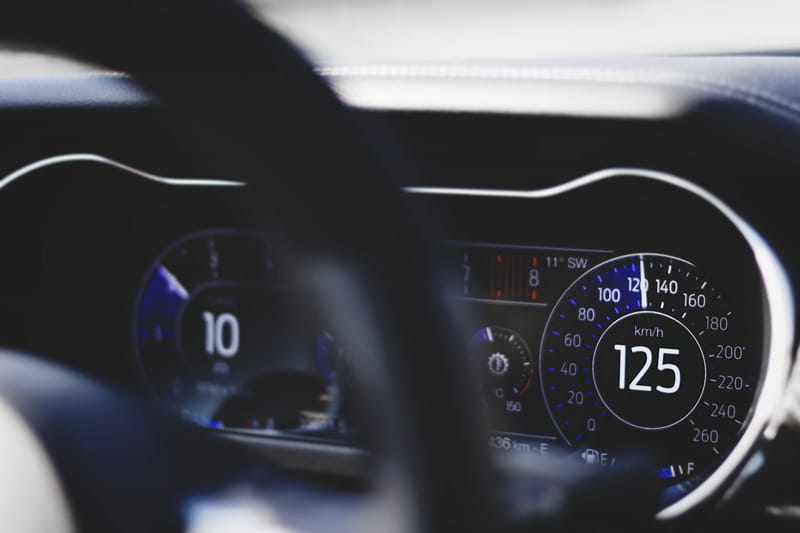
Driving at high revs in a low gear is one of the most fuel-hungry things you can do. As a rule of thumb, aim to change up at around 2,000 rpm in a diesel and 2,500 rpm in a petrol. Many modern dashboards include a gear shift indicator that suggests the optimal moment.
Use engine braking rather than coasting
When you lift off the accelerator in a modern car with the engine still in gear, most vehicles cut fuel delivery entirely during the deceleration phase. You are slowing down for free. Coasting in neutral requires the engine to idle continuously, consuming a small but steady amount of fuel. Anticipating stops and slowing in gear is a simple habit that makes a genuine cumulative difference.
Be strategic with air conditioning
Air conditioning places a real load on the engine and can increase fuel consumption by up to 10 per cent during city driving. At lower speeds, opening the windows is the more efficient option. At motorway speeds, the aerodynamic drag from open windows outweighs the saving, so air conditioning becomes the better choice above roughly 60 mph.
Plan routes to avoid stop-start traffic
Constant stopping and starting is one of the least efficient ways to drive. If you can take a slightly longer route that keeps you moving at a steady pace rather than sitting in queues, it will often be both faster and more economical. Apps such as Waze and Google Maps factor in real-time traffic and can suggest routes that avoid the worst congestion.
Pre-journey checks that pay for themselves
Many of the biggest fuel savings come from basic pre-journey habits. Our vehicle safety check covers the key systems that affect both safety and running costs, but there are things you can do yourself before every longer journey.
- Check tyre pressures cold, before the car has been driven, using a reliable gauge
- Clear the boot and roof of anything you do not need for the trip
- Confirm your MOT status and service history are up to date, particularly before a long run
- Fill up at a supermarket forecourt where possible, price comparison apps such as PetrolPrices and RAC Fuel Watch show that nearby stations can vary by 20p or more per litre right now
- Check that windows are clean and demisting systems are working, to avoid running the blower on full for extended periods
If your car is due an MOT, a pre-test inspection can also flag issues that might be quietly affecting your fuel economy. Our MOT testing includes a thorough check of engine, exhaust and emissions systems, all of which have a direct bearing on how efficiently the car runs.
A note for VW and Audi owners
Volkswagen and Audi vehicles are engineered to impressive efficiency standards from the factory, but that efficiency depends on the car being serviced correctly and on time. The direct-injection engines found across both ranges are particularly sensitive to carbon build-up on intake valves, a known issue that can reduce both power and economy if not addressed. Using the correct specification oil, changing it at the right interval and keeping the fuel system clean makes a measurable difference.
As an independent VW and Audi specialist based in Essex, we use manufacturer-grade diagnostic tools and the correct-spec parts and fluids, without the dealership price premium. If your VW or Audi feels like it is drinking more fuel than it used to, a diagnostic check and a proper service will almost always identify the cause.
Small changes, real savings
With fuel prices at their highest level in years and further uncertainty ahead, the case for driving efficiently has never been stronger. The good news is that none of it requires expensive technology or significant time. It is the accumulation of small, consistent habits: leaving a little more distance, changing up a gear earlier, keeping the tyres at the right pressure, and making sure the car is properly serviced.
If your car is due a service, a tyre check or an MOT, get in touch with us at Clover Autos. We are an independent specialist garage in Essex and our job is to keep your car running as well and as economically as possible.